How do you sell memberships without being pushy?
Eugen Esanu, Founder of TimiTomi6 min read
The short answer
Selling a membership is a conversation to find the right fit, not a pitch. Ask a new customer what they want and how often they can come, then suggest the one option that fits them. If the answer is “not now”, ask when, and write to them then. Keep following up until you hear a clear no.
Selling is a conversation, not a pitch
Many studio owners do not like to sell. When they hear the word, they think of a man in a suit who knocks on doors, or a gym that does not let you leave until you sign. So they teach a great class, smile at the new customer, and let them walk out with nothing booked.
Selling at a studio is something else. It is a conversation to find out whether your studio fits this person, and which of your options fits them best. From what we see, the studios that have this conversation early, and often, keep more of their new customers.
It is not pushy. It is part of your job. A customer who leaves without the right plan does not come back, and that does not help them or you.
Ask before you suggest anything
Start with questions, not with prices. Ask them after the first class, at the desk or in a message:
- What are your goals? To get stronger, to fix a sore back, to move after a day at a desk.
- How often can you come? Ask them to be honest, not hopeful.
- What have you tried before? And why did they stop?
- Which days and times work for you? Mornings, lunch, after work.
Listen more than you talk. The answers tell you what to offer. They also show the customer that you care about them, not about the sale.
Suggest one option that fits
Do not read your whole price list to them. A long list makes people think, and people who have to think say “I will decide later”. Suggest one option, and say why it fits what they told you.
- Twice a week, to fix a sore back: 8 classes a month.
- Once a week, with a job that travels: a pack of classes that does not expire at the end of the month.
- Not sure yet: the smallest membership, and a bigger one when they are ready.
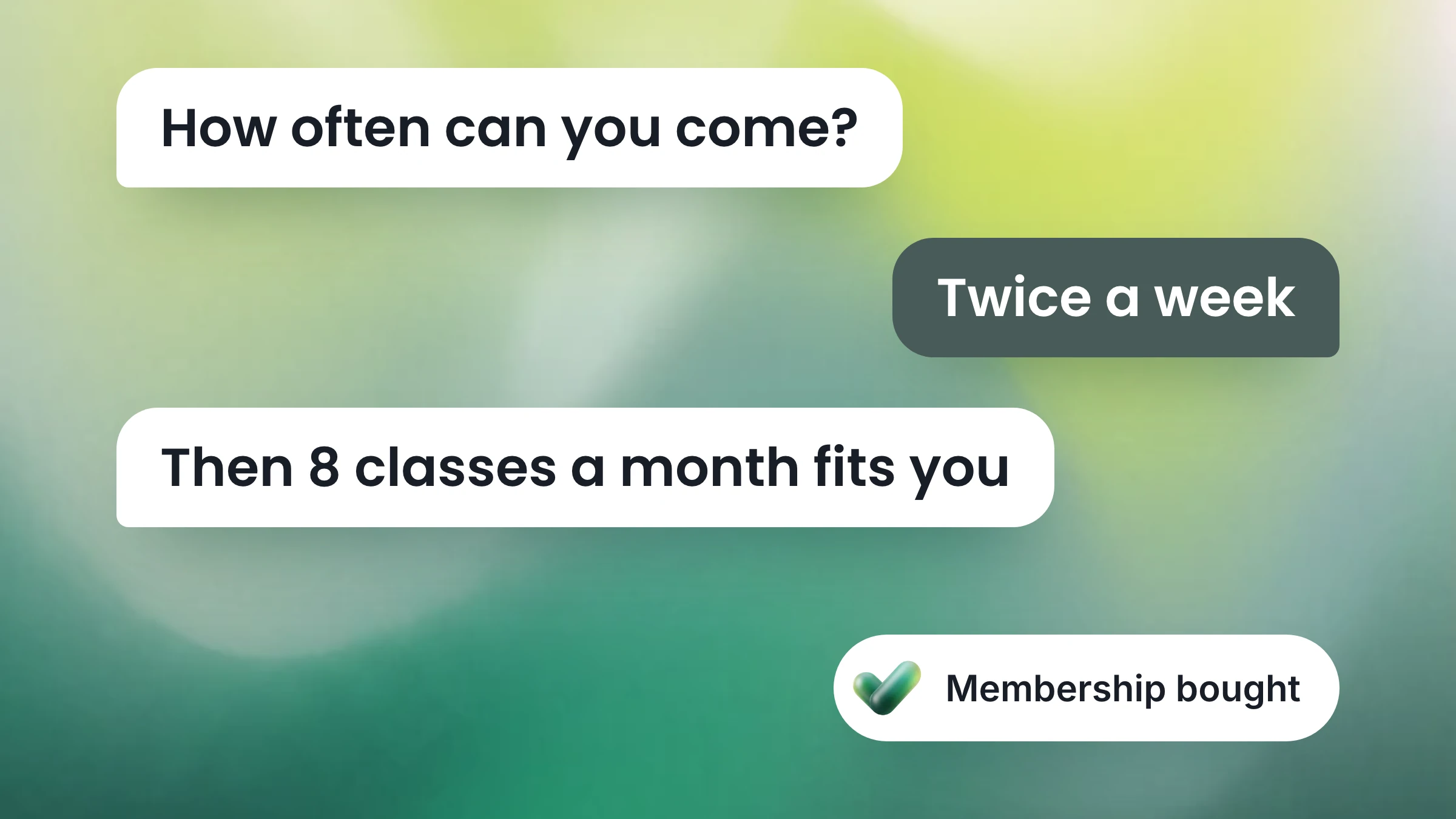
Hi Marta, how was your first class? What made you want to try Pilates?
I loved it! My back hurts from sitting all day.
Twice a week works best for that, so 8 classes a month fits you. Shall I book you Tuesday and Thursday at 18:00?
Yes, let’s do it
Bought: 8 classes a month
At our studio, most people who stay after the intro take 4 classes a month for €99, or our 5-class pack. We suggest one of the two, never the full list.
“Not now” is not a no
Often the answer is: not now. They travel next week, it is a busy month at work, or money is short until the end of the month. That is not a no. It is a question of when.
So ask when. “When could you start? In two weeks? After your holiday?” Write the date down, and tell them you will write to them then.
Most studios stop here. The customer leaves, nobody writes, and two weeks later your studio is one more thing they meant to do.
Follow up until you hear a no
Write to them on the day they gave you. If they gave no day, write one or two weeks later, and again three or four weeks later.
Keep each message short and personal, and remember what they told you: their goal, their holiday, the class they liked. A message that could go to anyone is the one that feels like sales.
Hi Lena, welcome back from your trip! You loved the Wednesday mat class. Shall I book it for you this week?
Yes! I am back and ready
Done. Want 4 classes a month, so Wednesday is yours every week?
Sounds good
Bought: 4 classes a month
Keep going until they give you a clear no. A no is a good answer: thank them, and stop. Silence is not a no. People are busy, and a kind message on the right day is often all they were waiting for.
Here is what that can look like for one customer: she said not now, got two short messages, and became a member.
- Said not now
- Two follow-ups
- Became a member
Month
Ten months as a member
What one follow-up is worth
At our studio, about half of our intro customers buy a pack or a membership after the intro. The other half is where follow-ups pay.
Say 10 people finish your intro this month, and 5 of them buy nothing. If your messages bring back only one of those 5, on a plan of $100 a month, and she stays ten months, that is $1,000 from a few short messages. Do that every month, and it is 12 more members a year.
Write down what they tell you
You will not remember what 30 new customers told you. Write it down right after the conversation: their goal, how often they want to come, when to write to them, and what they said no to.
Then each follow-up starts where the last conversation ended. “You said after your holiday. Welcome back! Shall I book you Tuesday?” works much better than “Hi, we have a special offer”.
In TimiTomi, you write these notes on the customer’s own profile, next to every class they booked and everything they bought, so anyone at the desk can continue the conversation.
When this is not right for you
- They said no. Thank them and stop. A clear no ends the follow-up, and you can still welcome them back one day.
- Most of your customers are visitors. A tourist here for three days will not become a member. Sell them a drop-in or a short pass, and do not write to them after they leave.
- You have many new faces every week. You cannot talk to every one of them yourself. Let automatic messages do the first follow-up, and keep your own conversations for the people who answer.
Follow-ups in TimiTomi
TimiTomi follows up for you, so no new customer leaves without a next step, even in the weeks you are too busy to write.
- No purchase yet. A customer who made an account and bought nothing gets a message with your offer.
- A checkout left before paying. Someone who started to pay and stopped gets a message that takes them straight back to it.
- Credits running low. An intro customer with one class left gets a reminder, with a discount code for their first pack or membership if you add one.
- A week with no booking. A customer who has not booked this week gets a reminder to book their next class.
- Notes on every customer. What they told you sits on their profile, next to every class they booked and everything they bought.
- Campaigns to a group. Write one email to every intro customer who has not bought yet, and send it once.
Every message has its own switch, its own timing and its own text, by email and by SMS. Build it all for free. You pay only when you go live.